Coverage and Feature Comparison
Every figure below comes straight from each product's own listing. Where a listing does not state a spec, it reads "Not stated" rather than a guess. Remember that stated coverage is a manufacturer "up to" figure, so discount it by your ACH target.
| Product | Stated Coverage | Filter Type | AQI Display | Certification | Price |
|---|---|---|---|---|---|
| Air Purifier HAP610WF (Large Room, Smart App) | Up to 3,850 ft² | Washable filter, HEPA | Yes, with trend graph | Not stated | $360.99 |
| Air Purifier (Washable Double-Sided, Smart WiFi) | Up to 3,000 ft² | Washable double-sided, HEPA | Yes | Not stated | $129.98 |
| KNKA APH4000 (White) | Up to 1,695 ft² in 1 hr | Washable pre-filter, HEPA | Yes | AHAM Verifide | $119.98 |
| KNKA APH4000 (Black) | Up to 1,695 ft² in 1 hr | Washable pre-filter, HEPA | Yes | AHAM Verifide | $119.99 |
| DBFIT H13 HEPA (Aromatherapy) | Up to 1,500 ft² | H13 HEPA | Not stated | Not stated | $49.99 |
| HEARBOBO (PM2.5 Sensors, Double-Sided 8X) | Up to 3,000 ft² | Washable, H13 HEPA double-sided | PM2.5 sensor | Not stated | $89.99 |
Last Updated: July 28, 2026
The products referenced on this page carry a combined 334+ verified Amazon customer ratings.

- 𝐀𝐇𝐀𝐌 𝐕𝐞𝐫𝐢𝐟𝐢𝐞𝐝 & 𝐇𝐢𝐠𝐡 𝐂𝐀𝐃𝐑 𝐕𝐚𝐥𝐮𝐞: Certified by the Association of Home Appliance Manufacturers, this air purifier provides reliable performance with a
- 𝐄𝐟𝐟𝐢𝐜𝐢𝐞𝐧𝐭 𝐀𝐢𝐫𝐟𝐥𝐨𝐰 𝐃𝐞𝐬𝐢𝐠𝐧: Engineered with dual front-and-back air intakes and dual side outlets, this purifier maximizes circulation for faster air exchange
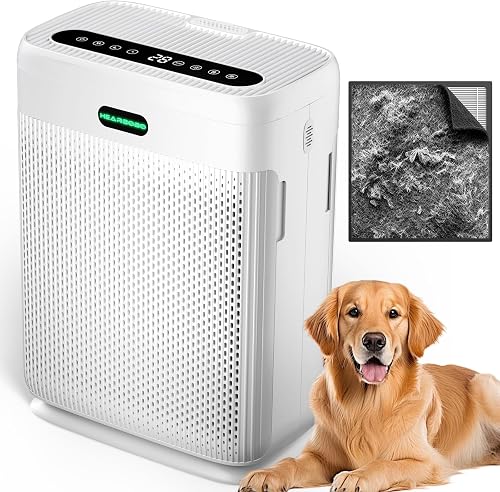
- EFFICIENT CIRCULATION PERFORMANCE: Traditional single-intake purifier pulls air from only one direction and may require poor air to travel farther across the room. HEARBOBO air
- WASHABLE PRE-FILTER, LOWER REPLACEMENT COSTS: The air purifier with washable filter removable black pre-filter can be vacuumed or rinsed with water to pet hair, lint, and large
The Short Answer
Measure your room's square footage, then buy a purifier whose clean air delivery rate (CADR) is at least two-thirds of that number for a standard 8-foot ceiling. If you have allergies, smoke, or pets, size up so the unit can turn over the room's air about 4 to 5 times an hour instead of the single turnover most "up to X ft²" labels quietly assume.
In plain terms: a box rated "up to 1,500 ft²" is usually a one-change-per-hour number, so treat it as roughly 300 to 375 ft² of real allergy-grade coverage. Read the label with that discount in mind and you will not be disappointed.
Why "Up To X Square Feet" Is Not What You Think
Almost every coverage figure on a purifier box is a single air change per hour (1 ACH) rating. One change per hour keeps a room mildly fresher, but it is far too slow to keep up with active pollen, cooking smoke, wildfire haze, or a shedding cat.
Air changes per hour is the real metric
For general freshness, 2 ACH is fine. For allergies and pets, aim for 4 ACH. For smoke and asthma, aim for 5 ACH. Every time you raise the ACH target, the room the purifier can actually handle shrinks. A unit that covers 1,500 ft² at 1 ACH only covers about 300 ft² at 5 ACH.
CADR is the number that cannot be gamed
CADR, measured in cubic feet per minute, tells you how much genuinely clean air the machine pushes out. A quick rule from the industry: your CADR (for smoke or dust) should be at least two-thirds of the room's floor area in square feet, assuming an 8-foot ceiling. A 300 ft² bedroom therefore wants a smoke CADR of about 200. When a listing gives you a CADR or an AHAM-verified rating, trust that over the marketing square footage.
Step-by-Step: Size It Correctly
Measure the room. Multiply length by width for square footage. Gotcha: measure the whole open space, not just the bedroom. If your bedroom opens into a hallway or a bathroom with no door, that air volume counts too.
Check the ceiling height. The two-thirds rule assumes 8 feet. If you have 9- or 10-foot ceilings, or a vaulted room, multiply your square footage by (ceiling height / 8) before you shop. Gotcha: lofts and older homes routinely have 10-foot ceilings, which quietly adds 25 percent more air to clean.
Pick your ACH target. Freshness only, choose 2. Allergies or pets, choose 4. Smoke or asthma, choose 5. Gotcha: be honest here. People buy for "general use," then get a cat, and the unit can no longer keep up.
Translate the label. Take the box's "up to" figure and divide by your ACH target. A "3,000 ft²" unit at 4 ACH is really a 750 ft² allergy machine. Gotcha: if the listing states a figure "in 1 hour," that is a 1 ACH claim by definition.
Prefer an AHAM-verified or stated CADR. If a product is AHAM Verifide or lists a CADR, use the two-thirds rule directly and ignore the inflated square footage. Gotcha: unverified "up to" numbers are self-reported and vary wildly between brands.
Confirm the noise on the setting you will actually run. Coverage claims assume the highest, loudest fan speed. If you will sleep on the quiet setting, real coverage on that setting is much lower. Gotcha: a "sleep mode" rated in the teens of decibels moves far less air than turbo.
Plan filter upkeep. A washable pre-filter delays clogging; a sealed HEPA still needs periodic replacement or cleaning per the maker's guidance. Gotcha: a clogged filter drops CADR sharply, so an oversized unit that is neglected can underperform a small clean one.
What Goes Wrong When Sizing Is Off
Undersized: the air never clears
Symptom: the AQI display hovers in the yellow or red, dust resettles within hours, and pet or cooking odors linger. Fix: either move the unit to a smaller closed room that matches its real ACH, or add a second unit. One correctly sized machine per room beats one big unit trying to serve a whole floor.
Oversized but always on low
Symptom: you bought a big unit, run it on the quietest setting to avoid noise, and still see poor air quality. Fix: a large unit only earns its rating on higher speeds. Use a model with a strong auto mode so it ramps up when the sensor detects particles, then settles down.
Doors and drafts defeat the math
Symptom: coverage feels worse than the spec sheet promised. Fix: close the door to the room being cleaned. An open floor plan turns your 200 ft² bedroom into a 900 ft² volume, and the purifier silently falls behind.
Placement chokes the intake
Symptom: the unit runs but readings barely move. Fix: pull it 6 to 12 inches off the wall and out from behind furniture so the intake and outlet are not blocked. A unit shoved into a corner recirculates its own clean air.
Neglected filter kills the CADR
Symptom: performance drops over months even though nothing else changed. Fix: rinse the washable pre-filter on schedule and replace or clean the HEPA per the manual. A dirty filter can cut effective delivery in half.
Notice that the KNKA APH4000 states its coverage "in 1 hr," which is an explicit 1 ACH figure. At an allergy-grade 4 ACH, treat that 1,695 ft² number as roughly 420 ft² of real coverage, and use the AHAM Verifide rating as your trustworthy anchor.
When the Fix Is a New One
Sometimes the honest answer is that no placement tweak or filter rinse will save an undersized or worn-out unit. Replace rather than fight it when: the AQI stays elevated even on high with the door closed, the fan is loud but readings barely move, the filter is spent and replacements cost nearly as much as a new machine, or your room is simply larger than anything you own can handle at 4 to 5 ACH.
If you need to cover a genuinely large or open space
The Air Purifier HAP610WF lists the largest coverage of this group at up to 3,850 ft², plus an AQI display with a trend graph and auto, eco, pet, and sleep modes, which matters because auto mode ramps the fan when particles spike so a big room is not left on a slow setting.
If you want a verified rating instead of a marketing number
The KNKA APH4000 is AHAM Verifide, which changes the sizing task because you can apply the two-thirds CADR rule to a third-party-checked figure rather than an unverified "up to" claim. It also adds a washable pre-filter and a dedicated pet mode.
If you want particle feedback to confirm your sizing is working
The HEARBOBO lists PM2.5 air-quality sensors and washable double-sided H13 HEPA, which helps here because a real-time PM2.5 reading lets you watch whether your chosen unit is actually keeping up in your room, not just trust the box.
Before buying any of these, open the listing and read the current owner reviews yourself, especially comments about real-world coverage and noise on the quiet setting. Treat those as a reality check on the stated square footage.
FAQ
What size air purifier do I need for a 300 square foot bedroom?
For a standard 8-foot ceiling and allergy-grade 4 ACH, aim for a smoke CADR near 200, or a listing whose "up to" figure is at least 1,200 ft² so it holds up after you discount for air changes. Close the door while it runs.
Is a bigger air purifier always better?
No. A big unit only delivers its rated coverage on higher, louder speeds. If you run an oversized machine on its quietest setting all night, its real output can fall below a smaller unit on medium. Match the size to the room and use auto mode.
How do air changes per hour relate to coverage claims?
Most "up to X ft²" labels assume just one air change per hour. Divide the label figure by your target ACH: use 4 for allergies and pets, 5 for smoke. A listing that says a coverage figure "in 1 hour" is stating a 1 ACH number by definition.
Does ceiling height change what size I need?
Yes. The two-thirds CADR rule assumes an 8-foot ceiling. For a 10-foot ceiling, multiply your square footage by 1.25 before sizing, because there is 25 percent more air in the room to clean.
Should I get one big purifier or several smaller ones?
Air does not flow freely between rooms through doorways, so one purifier per closed room almost always outperforms a single large unit trying to serve a whole floor. Size each unit to its own room and keep interior doors shut for best results.
Why is my correctly sized purifier still not clearing the air?
Check three things: the door is open and enlarging the space, the unit is jammed against a wall or furniture blocking airflow, or the filter is clogged and needs cleaning or replacement. Any one of these can cut effective delivery sharply even on a well-sized unit. For background on how home air cleaners work, see the EPA indoor air quality resources.