Specification and Coverage Reference
Coverage areas below are manufacturer claims. CADR is listed only where the source data provides it; where it does not, the honest entry is "Not stated," and you should back-calculate ACH from the coverage figure and your own room volume.
| Model | Rated Coverage | CADR | Filter | AQI Display | Notable |
|---|---|---|---|---|---|
| HAP610WF | Up to 3,850 ft² | Not stated | Washable HEPA | Yes, with trend graph | Smart app, Auto/Eco/Pet/Sleep modes |
| B0GHY6LBR1 | Up to 3,000 ft² | Not stated | Washable double-sided HEPA | Yes | Smart WiFi, 15 dB sleep mode |
| KNKA APH4000 | Up to 1,695 ft² in 1 hr | Not stated (AHAM Verifide) | HEPA + washable pre-filter | Yes | AHAM Verifide, Pet mode |
| KNKA APH4000 (Black) | Up to 1,695 ft² in 1 hr | Not stated (AHAM Verifide) | HEPA + washable pre-filter | Yes | AHAM Verifide, Pet mode |
| DBFIT H13 | Up to 1,500 ft² | Not stated | H13 HEPA | Not stated | Aromatherapy, portable |
| HEARBOBO | Up to 3,000 ft² | Not stated | Washable H13 double-sided 8X | PM2.5 sensor | Bedroom, dust, pets, smoke |
Last Updated: July 28, 2026
The products referenced on this page carry a combined 334+ verified Amazon customer ratings.

- 𝐀𝐇𝐀𝐌 𝐕𝐞𝐫𝐢𝐟𝐢𝐞𝐝 & 𝐇𝐢𝐠𝐡 𝐂𝐀𝐃𝐑 𝐕𝐚𝐥𝐮𝐞: Certified by the Association of Home Appliance Manufacturers, this air purifier provides reliable performance with a
- 𝐄𝐟𝐟𝐢𝐜𝐢𝐞𝐧𝐭 𝐀𝐢𝐫𝐟𝐥𝐨𝐰 𝐃𝐞𝐬𝐢𝐠𝐧: Engineered with dual front-and-back air intakes and dual side outlets, this purifier maximizes circulation for faster air exchange
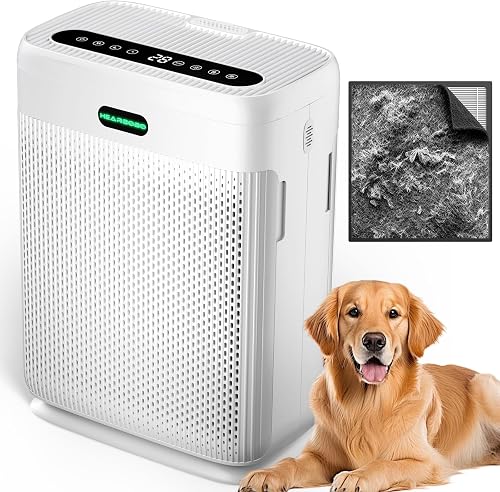
- EFFICIENT CIRCULATION PERFORMANCE: Traditional single-intake purifier pulls air from only one direction and may require poor air to travel farther across the room. HEARBOBO air
- WASHABLE PRE-FILTER, LOWER REPLACEMENT COSTS: The air purifier with washable filter removable black pre-filter can be vacuumed or rinsed with water to pet hair, lint, and large
The Short Answer
Air changes per hour (ACH) is the purifier's clean-air output per hour divided by the volume of your room. The formula is ACH = (CADR in CFM x 60) / (room floor area x ceiling height). Find the unit's CADR, measure your room's cubic footage, multiply CADR by 60 to get cubic feet cleaned per hour, then divide by room volume. For allergies, smoke, or pets you want 4-5 ACH; for general dust control 2-3 is fine.
What ACH Actually Measures
Air changes per hour tells you how many times a purifier can process a volume of air equal to your entire room in one hour. It is the single most useful number for matching a machine to a space, and it is almost never printed on the box.
Manufacturers advertise a coverage area in square feet instead, because a bigger number sells better. But a "3,000 ft²" rating and a "1,695 ft²" rating can hide wildly different real-world performance depending on the air-change level each brand chose to rate at. ACH cuts through that by tying output to your specific room.
Why 4-5 ACH Is the Target
One air change per hour barely keeps up with a lightly used room. At 2 ACH you get noticeable improvement in dust. At 4-5 ACH the machine is cycling your air roughly every 12-15 minutes, which is the level cited for allergy sufferers, wildfire smoke, and homes with pets. Chasing 6+ ACH gives diminishing returns and a lot more fan noise.
The Formula, Step by Step
Work through these in order. The gotcha at each step is where most people get a wrong answer.
Step 1 - Find the CADR
CADR (Clean Air Delivery Rate) is measured in cubic feet per minute (CFM) and is the honest output number. Look for it on the spec sheet or an AHAM Verifide listing. Gotcha: some listings only give square-foot coverage, not CADR. If so, skip to the "back-calculating" method below. Do not confuse fan airflow (raw CFM) with CADR; CADR already accounts for filtration efficiency and is always lower.
Step 2 - Measure your room's floor area
Multiply length by width in feet. Gotcha: use the real footprint, not the listing's marketing square footage. An open-plan kitchen-living room is one connected air volume, so measure the whole thing, not just the corner the purifier sits in.
Step 3 - Get the ceiling height
Standard ceilings are 8 ft. Gotcha: nearly every coverage claim assumes an 8-ft ceiling. If yours is 9, 10, or a vaulted 12 ft, your room volume jumps and your real ACH drops proportionally. A 10-ft ceiling instantly cuts a machine's effective ACH by 20 percent versus its 8-ft rating.
Step 4 - Calculate room volume
Volume = floor area x ceiling height. A 15 ft x 20 ft room with 8-ft ceilings is 300 x 8 = 2,400 cubic feet.
Step 5 - Convert CADR to cubic feet per hour
CADR x 60. A purifier with a 240 CFM CADR moves 240 x 60 = 14,400 cubic feet of clean air per hour. Gotcha: forgetting the x 60 is the single most common error; it makes people think a strong machine only delivers a fraction of one air change.
Step 6 - Divide and read the result
ACH = cubic feet per hour / room volume. 14,400 / 2,400 = 6 ACH in that room. Compare against your target: 4-5 for allergies and smoke, 2-3 for general dust.
Back-Calculating ACH From a Coverage Claim
When only a square-foot figure is given, note the ACH the brand rated it at. AHAM's standard coverage number is stated at a defined air-change level, and many brands publish a headline figure at just 1 or 2 ACH. If a unit is rated for a certain area "in 1 hour," that is its 1 ACH ceiling. Put it in a room a quarter of that size and you get roughly 4 ACH. That is why matching a large-area unit to a small bedroom is the easiest way to hit 4-5 ACH.
What Goes Wrong
You used marketing square footage as gospel
Symptom: the air still feels stuffy or your AQI display stays high even though the box "covers" your room. Fix: recompute using CADR and your actual cubic footage, not the coverage sticker. Coverage claims often assume 8-ft ceilings and a low target ACH.
You ran the unit on a low or sleep setting
Symptom: calculated ACH looks great on paper but performance is poor. Fix: CADR is measured at the highest fan speed. A 15 dB sleep mode or an auto eco setting throttles airflow dramatically, so your real overnight ACH can be a third of the rated figure. Run high for an hour, then drop to sleep to maintain.
Your ceiling is taller than 8 feet
Symptom: the room takes far longer to clear than the math predicted. Fix: redo Step 3 with the true height. Vaulted and loft spaces routinely need a unit rated for double the floor area to hit the same ACH.
The room isn't sealed
Symptom: AQI drops while doors are shut, then climbs the moment they open. Fix: ACH assumes a bounded volume. Open doorways to hallways or adjoining rooms effectively enlarge the volume, diluting your air changes. Close the door or size up.
The filter is loaded
Symptom: a machine that used to clear the room now lags. Fix: a clogged HEPA or pre-filter chokes airflow and drops real CADR below the rating. Clean washable pre-filters on schedule and replace HEPA media per the maker's interval before blaming the math.
The KNKA APH4000 is the one unit here carrying an AHAM Verifide mark, meaning its coverage claim is measured to a published standard rather than an in-house method. That "1,695 ft² in 1 hr" wording is effectively a 1 ACH ceiling, so in a 400 ft² bedroom it delivers roughly 4 ACH.
When the Fix Is a New One
Sometimes the math shows the machine simply cannot reach your target ACH no matter what you adjust. These are the honest signals to stop tweaking and re-size.
Your calculated ACH stays under 3 on high
If a unit maxes out below 3 ACH in your actual room volume, it is undersized for allergy or smoke duty. A machine rated for a much larger area gives you headroom to hit 4-5 ACH while running quietly on a mid setting. The KNKA APH4000 (AHAM Verifide, up to 1,695 ft² in 1 hr) is built around a verified coverage number, which makes back-calculating your real ACH straightforward. Check Price on Amazon
You need one machine to cover an open great room
Open-plan spaces enlarge the air volume you divide into, so oversizing is the only way to keep ACH up. The HAP610WF (up to 3,850 ft², washable HEPA, AQI display with trend graph) gives the largest rated coverage in this group, and its trend graph lets you watch whether your air actually clears at the speed your ACH math predicts. Check Price on Amazon
Your current unit chokes because the filter can't be cleaned
Airflow loss from a clogged, non-washable filter permanently drags real ACH below the rating. A washable-filter design keeps output closer to spec over time. The HEARBOBO (up to 3,000 ft², washable H13 double-sided filters, PM2.5 sensor) pairs washable media with a live particulate sensor so you can confirm the room is actually clearing. Check Price on Amazon
Before buying, open the current Amazon listing and read owner reviews yourself, especially any that mention noise at high speed and real clearing times, since those are the numbers your ACH calculation depends on.
FAQ
How many air changes per hour do I need for smoke?
Aim for 4-5 ACH for wildfire smoke or indoor smoke. That cycles your air roughly every 12-15 minutes, which is what keeps fine particulate from rebuilding between cleanings.
What is the difference between CADR and coverage area?
CADR is a measured airflow-of-clean-air rate in CFM. Coverage area is a marketing translation of that rate at a chosen ACH and an assumed ceiling height. CADR is the number to trust; coverage area is only as honest as the ACH the brand rated it at.
My purifier lists square feet but no CADR. Can I still find ACH?
Yes. Note the ACH the coverage was rated at (often 1 or 2), then scale by room size. A unit rated for a given area at 1 ACH delivers about 4 ACH in a room one quarter that size, assuming an 8-ft ceiling.
Does sleep mode change my air changes per hour?
Significantly. CADR is measured at top speed, so a 15 dB sleep or auto-eco setting can cut real ACH to a third or less. Run the machine on high to clear the room, then drop to a quiet mode to hold it.
Do taller ceilings really matter for ACH?
Yes, directly. ACH divides by room volume, and volume rises with ceiling height. A 10-ft ceiling raises volume 25 percent over an 8-ft room of the same footprint, cutting your effective ACH by the same proportion.
Is more air changes per hour always better?
Up to a point. Beyond 5-6 ACH you gain little additional particle reduction while adding noise and energy use. Match ACH to the room's job rather than maximizing it.