Specification and Coverage Reference
Every figure below comes straight from the product listings. Where a listing does not state a spec, it reads "Not stated" rather than a guess.
| Product | Rated Coverage | Filter Type | AQI Display | Price |
|---|---|---|---|---|
| HAP610WF Large Room Air Purifier | Up to 3,850 ft² | Washable HEPA | Yes, with trend graph | $360.99 |
| Washable Double-Sided Filter Purifier (B0GHY6LBR1) | Up to 3,000 ft² | Washable double-sided HEPA | Yes | $129.98 |
| KNKA APH4000 (B0FNDG2TNK) | Up to 1,695 ft² in 1 hr | HEPA with washable pre-filter | Yes | $119.98 |
| KNKA APH4000 Black (B0GCMGN8C8) | Up to 1,695 ft² in 1 hr | HEPA with washable pre-filter | Yes | $119.99 |
| DBFIT H13 HEPA Purifier | Up to 1,500 ft² | H13 HEPA | Not stated | $49.99 |
| HEARBOBO Double-Sided 8X Purifier | Up to 3,000 sq.ft | Washable H13 HEPA, double-sided | PM2.5 sensor | $89.99 |
Last Updated: July 28, 2026
The products referenced on this page carry a combined 334+ verified Amazon customer ratings.

- 𝐀𝐇𝐀𝐌 𝐕𝐞𝐫𝐢𝐟𝐢𝐞𝐝 & 𝐇𝐢𝐠𝐡 𝐂𝐀𝐃𝐑 𝐕𝐚𝐥𝐮𝐞: Certified by the Association of Home Appliance Manufacturers, this air purifier provides reliable performance with a
- 𝐄𝐟𝐟𝐢𝐜𝐢𝐞𝐧𝐭 𝐀𝐢𝐫𝐟𝐥𝐨𝐰 𝐃𝐞𝐬𝐢𝐠𝐧: Engineered with dual front-and-back air intakes and dual side outlets, this purifier maximizes circulation for faster air exchange
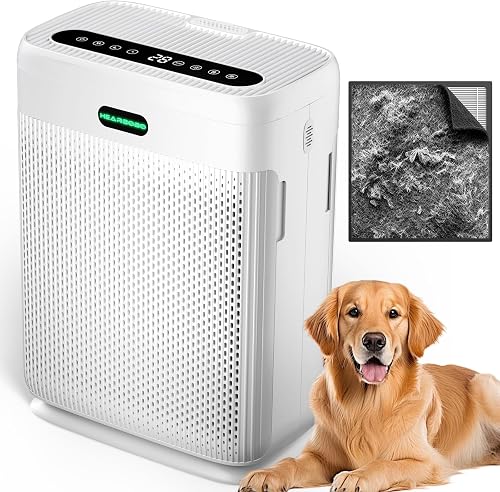
- EFFICIENT CIRCULATION PERFORMANCE: Traditional single-intake purifier pulls air from only one direction and may require poor air to travel farther across the room. HEARBOBO air
- WASHABLE PRE-FILTER, LOWER REPLACEMENT COSTS: The air purifier with washable filter removable black pre-filter can be vacuumed or rinsed with water to pet hair, lint, and large
The Short Answer
A working indoor air quality checklist for a home runs in four moves, in this order: remove or reduce pollution sources, ventilate to dilute what is left, filter the air with a correctly sized HEPA unit, and measure so you know it actually improved. Do them out of order and you will spend money filtering air you are still actively polluting. The steps below walk each one with the mistake that trips people up.
Why the Order Matters
Indoor air is usually two to five times more polluted than the air outside, and the causes are almost always inside the house: cooking, cleaning products, dust, pet dander, combustion appliances, and moisture that feeds mold. Filtration is the visible part, but it is the last line, not the first.
If you skip source control, your filter runs constantly, clogs faster, and never wins. If you skip measurement, you have no idea whether anything changed. Treat this as a system, not a single purchase.
The Room-by-Room Checklist
Work through these in sequence. Each step lists the gotcha that quietly wastes the effort of the step.
Step 1: Find and cut the sources
Walk each room and list what puts particles or gases into the air: gas stove, candles, aerosol sprays, scented plug-ins, a litter box, a damp basement corner, new furniture off-gassing. Switch what you can to fragrance-free, lid the litter box, and stop burning things indoors.
Gotcha: the biggest source is usually the kitchen, and most people never use the range hood. If your hood recirculates instead of venting outside, it is not removing cooking smoke, only spreading it.
Step 2: Fix moisture before it becomes mold
Aim for relative humidity between 30 and 50 percent. Check bathrooms, under sinks, and basements for leaks or condensation. Run exhaust fans during and after showers, and use a dehumidifier in any space that reads above 55 percent.
Gotcha: a purifier does nothing for mold spores that keep regenerating from a wet surface. Dry the source first or you filter forever.
Step 3: Ventilate to dilute
Open windows on opposite sides of the house for ten to fifteen minutes to create cross-flow, especially after cooking, cleaning, or anything with strong fumes. In wildfire smoke or high-pollen season, keep windows shut and lean harder on filtration instead.
Gotcha: ventilating during a bad outdoor-air day pulls the problem inside. Check the outdoor AQI before you open anything.
Step 4: Change your HVAC filter and seal the return
Replace the furnace or central-air filter on schedule (most are one to three months) and step up to a higher-MERV filter your system can handle. A dirty filter chokes airflow and stops trapping fine dust.
Gotcha: a high-MERV filter in a system not rated for it restricts airflow and can strain the blower. Match the filter to what the unit tolerates.
Step 5: Size a portable air purifier to the room
Put a HEPA purifier in the rooms where people spend the most time, usually the bedroom and the main living space. Match the unit's rated coverage to the room's square footage, and give yourself headroom so it can run on a lower, quieter speed.
Gotcha: a unit rated for a huge area "in one hour" only hits that number on its loudest setting. If you want it quiet at night, buy more coverage than the room strictly needs.
Step 6: Place it where air can actually move
Set the purifier with at least a foot or two of clearance on the intake and outlet sides, off the floor if the design pulls from the front, and away from corners and behind furniture. Keep it in the same room as the people, not in a hallway.
Gotcha: shoving it against a wall or under a shelf strangles airflow. The rated coverage assumes the air can circulate freely around it.
Step 7: Measure and set a baseline
Use the unit's AQI display or a standalone PM2.5 monitor to record numbers at the same times each day. Note what the reading does when you cook, vacuum, or open a window. That baseline is how you prove the system works.
Gotcha: a single reading means nothing. Trends over days are what tell you whether a change helped.
Step 8: Maintain the filters
Vacuum or wash any washable pre-filter on schedule, and replace sealed HEPA media when the indicator or the airflow tells you to. Set a calendar reminder so it is not left to memory.
Gotcha: a washable pre-filter must be bone dry before it goes back in. Reinstalling it damp invites the exact mold problem you are trying to avoid.
What Goes Wrong
These are the failure modes that make people think their air quality project failed when it was really a setup problem.
The numbers never drop
Symptom: the AQI display sits high no matter how long the purifier runs. Fix: you almost certainly have an active source you have not cut, a purifier too small for the room, or a clogged filter. Recheck Steps 1, 5, and 8 before blaming the device.
Persistent odor even with a purifier running
Symptom: cooking, pet, or smoke smells linger. Fix: most standard HEPA media captures particles, not gases and VOCs. You need a unit with meaningful activated-carbon capacity and better source control at the kitchen and litter box.
It is too loud to leave on
Symptom: you switch it off at night, so it protects nobody while you sleep. Fix: oversize the unit so its low or sleep mode still clears the room, and place it a little farther from the bed.
Humidity swings and musty smell
Symptom: condensation on windows, a damp basement odor. Fix: that is a moisture problem, not a filtration one. Add a dehumidifier and fix the leak; the purifier is the wrong tool here.
Allergy symptoms unchanged
Symptom: sneezing and congestion continue despite everything running. Fix: soft furnishings hold allergens. Wash bedding hot weekly, vacuum with a sealed HEPA vacuum, and confirm the purifier actually covers the bedroom, not the hallway outside it.
Coverage claims stated "in 1 hour" or "up to" typically reflect the maximum fan speed. For quiet overnight operation, treat the effective coverage as smaller than the headline number. Before buying any of these, go read the current owner reviews on the product page yourself to see how the numbers hold up for people in rooms like yours.
When the Fix Is a New One
Keep working the checklist as long as the basics respond. But replace the purifier rather than fighting it when you see these honest signals: the filter is discontinued or costs nearly as much as a new unit; the fan can no longer clear the room even on high; there is no AQI feedback so you are flying blind; or the unit is simply too small for the space you actually need to cover. Here is what specific units change for this task.
When you need to blanket a large open-plan space
If your problem is one big room or a combined living-and-kitchen area, coverage headroom is the thing that matters, because it lets the unit run quiet instead of maxed out. The HAP610WF is rated up to 3,850 ft² with a washable filter and a trend graph that shows whether your numbers are actually falling over time.
When you want a verified bedroom baseline
For a bedroom where you want a defensible coverage figure and simple maintenance, the KNKA APH4000 is AHAM Verifide, rated up to 1,695 ft² in one hour, and uses a washable pre-filter so ongoing cost stays low. It carries an AQI display so you can watch the trend from Step 7.
When you want to keep recurring cost near zero
If replacement-filter cost is what pushed you to give up on your last unit, a washable-filter design changes the math. The HEARBOBO uses washable double-sided H13 HEPA, is rated up to 3,000 sq.ft, and includes a PM2.5 sensor so you keep a live reading without buying cartridges.
Frequently Asked Questions
What should I check first when air quality feels bad?
Start with sources, not devices. Check the kitchen range hood, any candles or scented sprays, the litter box, and damp spots. Cutting the source does more, faster, than any filter you can buy.
What is a good indoor air quality reading?
For fine particles, a PM2.5 reading in the single digits to low teens (micrograms per cubic meter) is generally considered good, and humidity between 30 and 50 percent keeps mold and dust mites in check. Track your own baseline and watch the trend rather than one snapshot.
Do I need a purifier in every room?
No. Prioritize the bedroom and the main living space where you spend the most hours. A single oversized unit in an open-plan area often beats several small ones scattered around.
Do air purifiers remove smells and gases?
Standard HEPA media captures particles, not odors or VOCs. For smells you need meaningful activated-carbon capacity plus source control at the kitchen and litter box. Confirm carbon content on the product page before assuming a unit handles odor.
How often should I run it and when do I clean the filter?
Run it continuously on a low or auto setting; portable HEPA units are designed for it and use little power. Wash any washable pre-filter on the maker's schedule, dry it completely before reinstalling, and replace sealed media when airflow drops or the indicator prompts you.
Where can I learn more about home air quality basics?
The U.S. Environmental Protection Agency maintains general guidance on indoor air pollutants and control strategies. See the EPA Indoor Air Quality resource for the underlying source-control and ventilation principles this checklist is built on.